
Do Argentina and Spain speak the same Spanish?
Yes and no. Argentina and Spain both speak Spanish, and a Porteño from Buenos Aires and a Madrileño understand each other perfectly — but they say "you" differently, pronounce whole letters differently, and reach for wholly different everyday words. It's one language wearing two very distinct outfits. And this Sunday, 19 July, at MetLife Stadium, the two accents walk onto the same pitch: the reigning world champions against the reigning European champions, and for a language nerd it isn't just Messi vs Yamal — it's vos vs tú.
Picture the tunnel. On one side, Argentina: Lionel Messi in his third World Cup final, eight goals deep into the tournament, dragging a nation behind him one more time. On the other, Spain: Lamine Yamal, nineteen years old, a Barcelona winger playing his first final and somehow looking like he owns the place. They're club teammates. They'll shake hands. And the moment they open their mouths, you'd hear two different Spanish languages — not dialects with a couple of funny words, but genuinely different grammar, sounds and vocabulary.
Spanish is spoken by roughly half a billion people across twenty-odd countries, and it never agreed to hold still. Argentina and Spain are the two loudest, proudest examples of that. So before you pick a side on the football, let me walk you through the linguistic derby.
Vos vs tú: the "you" problem
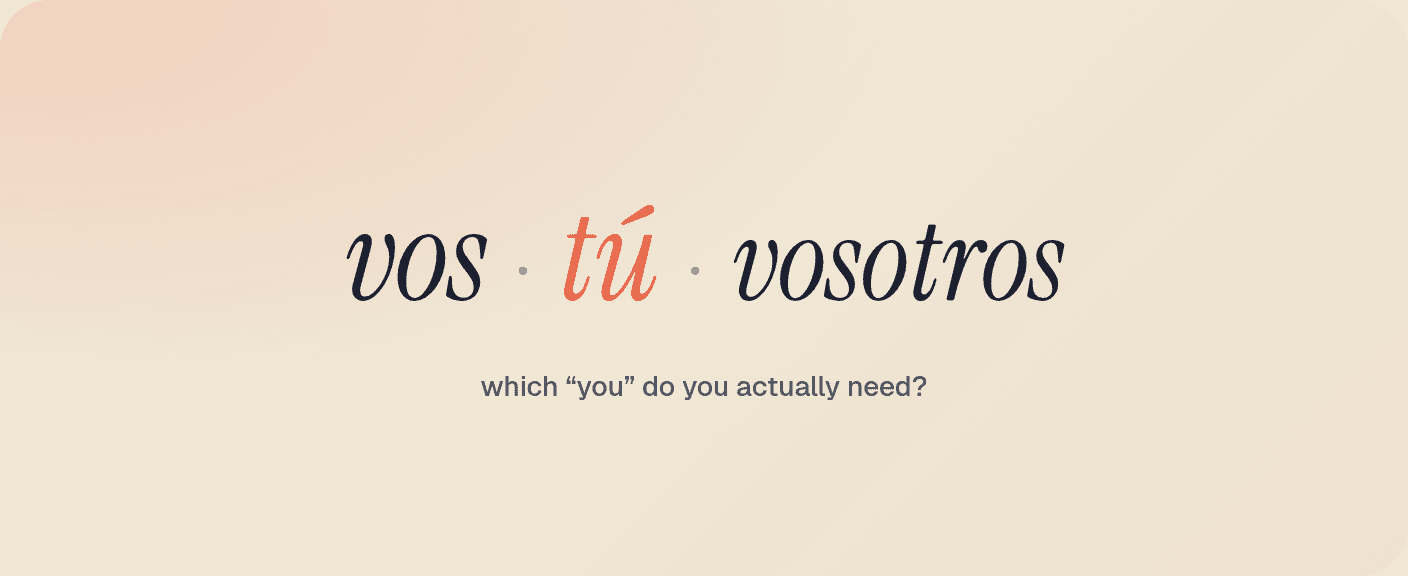
Take the most basic word in any language — "you" — and the two teams already disagree. In Spain, informal "you" is tú. Tú tienes, tú eres, ¿de dónde eres? Standard textbook stuff. In Argentina they use vos instead — a phenomenon called voseo — and it comes with its own verb endings. So "you have" isn't tú tienes, it's vos tenés. "You are" isn't tú eres, it's vos sos. Ask someone where they're from and it's ¿de dónde sos? Give a command and it shifts again: Spain says ven, mira, dime ("come, look, tell me"), while Argentina says vení, mirá, decime, with the stress hopping onto that final syllable.
The plural flips the whole thing on its head. For "you all" spoken informally, Spain is the odd one out with vosotros — vosotros tenéis, ¿vosotros venís? Argentina, along with the entire rest of Latin America, just uses ustedes for everybody, formal or not. So the country that keeps an extra pronoun for the singular (vos) drops the one Spain guards for the plural. Nobody planned this. Language never does.
The Buenos Aires "sh" and a very Italian accent
Even when the words match, the sound gives the game away instantly. In most of the Spanish-speaking world, the letters "ll" and "y" make a sound close to the English "y" in "yes". In Buenos Aires they turn into a soft "sh" or "zh" — a feature called yeísmo rehilado. So yo me llamo ("my name is"), which most learners say as "yo me yamo", comes out of a Porteño mouth as "sho me shamo". It's the single fastest way to spot an Argentine anywhere in the world.
Then there's the melody. Argentine Spanish has a famously sing-song, up-and-down intonation that sounds, to a lot of ears, unmistakably Italian — and that's history, not coincidence. Between the 1860s and the 1920s, huge waves of Italian immigrants arrived in Buenos Aires, and the local Spanish absorbed the rhythm of their speech. Spanish from Spain, by comparison, sounds crisper and flatter, with that distinctive th sound for "c" and "z" (Barcelona becoming "Barthelona"). Two entirely different pieces of music.
Strawberries, avocados, and one word to never mix up
Order a strawberry milkshake in Buenos Aires and you ask for frutilla; in Madrid it's fresa. This is where it gets genuinely practical — not slang, just ordinary grab-it-off-the-shelf vocabulary that never agreed across the Atlantic.
And one genuine warning, the kind that saves you real embarrassment: the verb coger. In Spain it's about the most ordinary word going — "to take" or "to grab", used constantly. Voy a coger el autobús, "I'm going to catch the bus". In Argentina, coger is vulgar slang for having sex, and only that. So a Spaniard cheerfully announcing they're going to coger un taxi will get a very different reaction in Buenos Aires. When you're in Argentina, use agarrar or tomar instead. This is the single most useful thing in this entire article.
- Strawberry: frutilla in Argentina, fresa in Spain.
- Avocado: palta in Argentina, aguacate in Spain.
- Car: auto in Argentina, coche in Spain.
- Jacket: campera in Argentina, chaqueta in Spain.
- Swimming pool: pileta in Argentina, piscina in Spain.
- Pastries: facturas in Argentina (order those with your morning coffee and thank me later).
Slang lives on separate planets
The everyday words already diverge; the slang doesn't even share a solar system. Argentina's street language is lunfardo, born in the working-class neighbourhoods of Buenos Aires in the late 1800s. You'll hear che constantly (roughly "hey" or "mate", the all-purpose attention-getter, which is how Che Guevara got his nickname), boludo/a (technically "idiot", but between friends it's affectionate, almost punctuation), dale ("okay", "go on", "come on"), and laburo ("work", straight from the Italian lavoro).
Spain has its own colourful kit, and almost none of it overlaps. Vale is the constant "okay" (you'll hear it forty times a day), guay means "cool", tío and tía mean "dude" and "mate", and flipar means to be amazed or lose your mind over something. A Spaniard says vale, qué guay, tío. An Argentine says dale, bárbaro, che. Same sentiment, zero shared words.
The one place they finally agree: football
The vocabulary that unites the two teams is, fittingly, the vocabulary of the thing they're fighting over. Football words travel beautifully across the Spanish-speaking world: gol is gol everywhere, córner is córner, and campeón is the champion everyone wants to be by Sunday night. Even "the ball" mostly agrees — it's pelota in Argentina and balón in Spain, but everyone understands both. When Messi scores, a stadium full of Argentines and a bar full of Spaniards shout the exact same word — drawn out, deafening, identical. For ninety minutes, the language finally agrees on something.
So which Spanish should you learn?
If all this makes you want to throw the textbook out the window, don't. Good news: tú is understood everywhere — the safe default that works from Madrid to Mexico City to Buenos Aires, and nobody will ever be confused if you use it. From there you simply add: pick up vos if you're heading to Argentina or Uruguay, and you only really need vosotros for Spain. It's not two languages to learn. It's one, with regional settings.
A textbook will always let you down a little here, because it has to pick one — Spain's vosotros or neutral Latin American tú — and quietly pretend the other doesn't exist. Real Spanish is alive precisely because Argentina and Spain refuse to speak it the same way, which is why learning from real video works so well. With Lingooso you pick a YouTube video in Spanish — a Buenos Aires vlogger, a Madrid match report, whatever you fancy — and it becomes flashcards, vocabulary highlights and quizzes, so you're studying the actual accent and slang of real people as you watch. Play an Argentine and a Spaniard back to back and you'll hear every difference this article just described. Oso, our honey-bear in his round glasses, is quietly cheering for both sides — he just wants you talking.